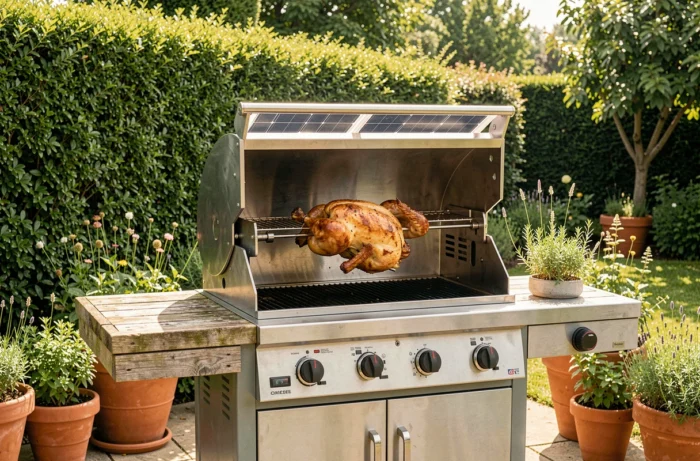
Cooking a piece of meat in the garden without using gas, charcoal, or electricity: the solar rotisserie offers exactly that. The device combines a parabolic or cylindrical-parabolic reflector with a rotation mechanism powered by a small photovoltaic panel or by the heat itself. Before adopting it, one must measure what it actually changes compared to a classic barbecue, both in thermal terms and in daily usage constraints.
Solar rotisserie vs. classic barbecue: performance comparison
There is often confusion between a solar cooker (which concentrates the sun’s heat to cook food) and a motorized rotisserie powered by a photovoltaic panel. The former directly captures radiation, while the latter uses solar energy only to turn the spit, with the heat source potentially remaining charcoal. Checking the type of mechanism before purchase avoids disappointment.
| Criteria | Solar rotisserie (direct cooking) | Classic charcoal barbecue | Gas barbecue |
|---|---|---|---|
| Heat source | Concentrated solar radiation | Combustion of charcoal | Combustion of propane/butane |
| Temperature range | Gentle cooking, around 100 to 150 °C | High grilling, over 250 °C | Adjustable from 150 to 300 °C |
| CO2 emissions | None during operation | High (combustion + transport of charcoal) | Moderate (gas combustion) |
| Weather dependency | High (direct sunlight required) | None | None |
| Cooking time | Significantly longer | Short | Short to medium |
The SunGood + Cosmo cooker, for example, claims a cooking range of 100 to 150 °C with variable durations depending on the piece. This temperature regime excludes the quick searing of a steak but is well-suited for slowly roasted chicken or confit vegetables.
The data found on the Energie O’ Solr website helps refine the understanding of how these devices operate in a domestic garden context.
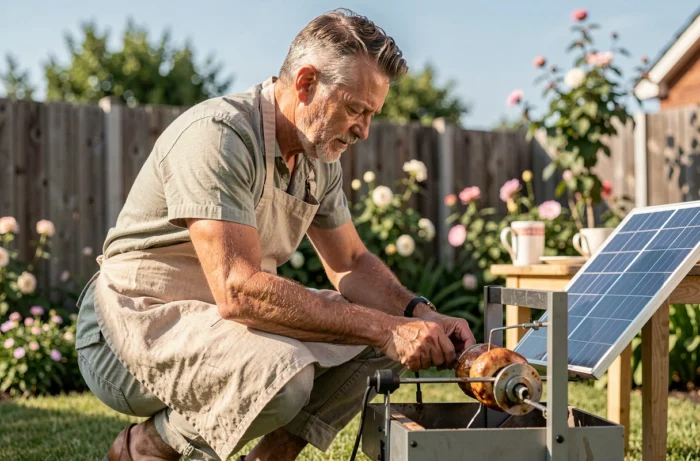
Orientation and weather constraints: what solar cooking really demands
A charcoal barbecue can be lit in the rain with makeshift shelter. A solar rotisserie cannot. The device requires direct and continuous sunlight, which reduces the usage window in the northern half of France to just a few months a year.
The recommendations published by Greenweez emphasize three practical points:
- The location must be completely clear, without trees or buildings casting shade on the reflector during the cooking duration.
- The device must be regularly reoriented to follow the sun’s path, which implies active presence rather than autonomous cooking.
- The ideal cooking hours correspond to when the sun is highest, typically between 11 AM and 3 PM in summer, which requires planning the meal around this window.
This weather dependency explains why the solar rotisserie works better as a complementary device rather than a total replacement for the barbecue. Having a plan B on cloudy days remains necessary.
Slow cooking vs. grilling: two barbecue philosophies
The temperature range of a solar cooker naturally leads to slow cooking, akin to low-temperature baking. Fans of marked grilling and Maillard crusts will not find satisfaction here.
On the other hand, a whole chicken on a rotating spit under a parabolic reflector develops flavors similar to those of a traditional rotisserie. The constant rotation ensures even cooking that fixed grilling does not guarantee. The solar method excels with large pieces cooked slowly.
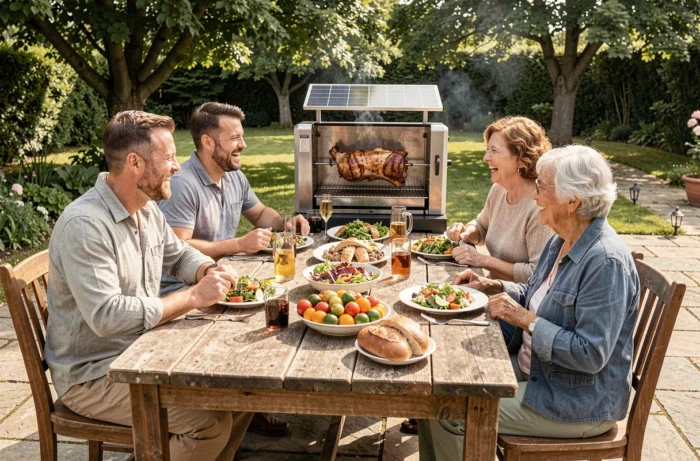
Safety of a solar barbecue in the garden: absence of flame and real precautions
The main commercial argument for the solar barbecue is the absence of flame. No glowing charcoal, no pressurized gas, no grease splattering on a combustion source. The risk of fire in dry conditions significantly decreases.
The absence of flame does not mean the absence of risk. The reflector concentrates solar radiation at a focal point whose temperature is sufficient to cause severe burns on contact. Metal surfaces heated by the sun also reach high temperatures.
- Never look directly at the focal point of the reflector, which can damage the retina like direct exposure to the sun.
- Keep children and pets away from the concentrator throughout the cooking duration.
- Use heat-resistant gloves to handle the spit and reflector, even after moving the device out of the sun.
These precautions are less burdensome than managing a charcoal barbecue (extinguishing coals, storing ashes), but they deserve serious attention.
Maintenance and durability of a solar rotisserie
The reflector is the centerpiece of the device. Its ability to concentrate radiation directly depends on the condition of its surface. A tarnished reflector loses a significant part of its thermal efficiency. Regular cleaning with a soft cloth and a non-abrasive product maintains performance.
The rotation mechanism, whether powered by a small photovoltaic panel or by a manually wound spring, requires little maintenance. Photovoltaic models generally incorporate a low-voltage motor whose lifespan far exceeds that of the reflector itself.
The structural weak point remains the fragility of the reflector against the elements. Wind can deform a lightweight parabolic reflector, and hail can scratch the reflective surface. Storing the device sheltered between uses significantly extends its lifespan.
The solar rotisserie is not a universal substitute for the barbecue. Its playground is slow cooking, in full sun, for meals planned around the weather. It is a device for patient conviviality, not for express grilling. For those who accept this constraint, it eliminates any fuel expenditure and emissions during cooking, making it the most eco-friendly option on the market.