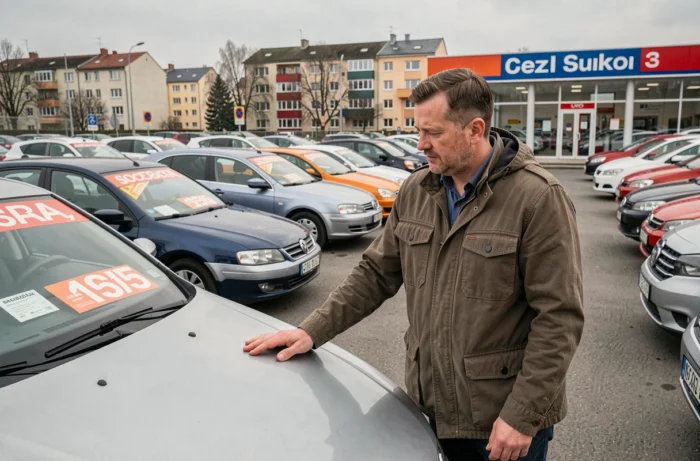
Buying a car in Poland attracts French buyers every year who are tempted by prices significantly lower than those in the hexagonal market. The difference in purchasing power between the two countries drives prices down, especially in the used car segment. Before diving in, it’s better to understand what really generates the savings and what might nibble away at them along the way.
Historia Pojazdu: check the history of a Polish vehicle before purchase
Competitors talk a lot about prices and procedures. Few detail the actual verification of the vehicle on-site. Yet, this is the first step that separates a good deal from an expensive trap.
Poland has an official service, Historia Pojazdu, which allows you to consult technical inspection records and certain elements of the history of a vehicle registered in the country. To access it, you need three pieces of information: the registration number, the VIN, and the date of first registration.
This service has a significant limitation. If the vehicle was registered in another country before Poland (in Germany, for example, a common case), the data prior to its arrival may be incomplete. You should then demand from the seller the invoices, maintenance logs, and registration documents from the country of origin.
For mileage, a single reading is not enough. Compare several dated readings (technical inspections, intervention invoices) to reconstruct a timeline. Any inconsistency between two dates, even slight, should alert you. If the seller cannot provide proof, it’s better to walk away. As you can read on Automotech, vigilance regarding the history remains the best investment before any transaction.

VAT on a vehicle imported from Poland: the rule of the new vehicle in European terms
You are buying a used car from a Polish private seller, so no VAT to pay in France? This is not always true. Taxation depends on a precise European definition, and ignoring it can be very costly.
When French VAT applies
The European Union considers a vehicle to be “new” if it meets at least one of these two conditions:
- Its first registration was less than six months before the date of purchase
- It has traveled less than 6,000 kilometers on the odometer
A vehicle that ticks one of these boxes is subject to French VAT upon importation, even if it was purchased from a private individual. The applicable rate is the one in force in France. This rule often surprises buyers who think they can escape any tax on a transaction between individuals within the EU.
When the vehicle is considered used
If the vehicle exceeds six months and 6,000 kilometers, it is “used” in European tax terms. In this case, purchasing from a Polish private seller does not incur additional VAT in France. However, if you buy from a Polish professional, the invoicing of VAT depends on the regime applied by the seller (margin or intra-community).
Always check the VAT regime mentioned on the invoice before leaving the seller. A mistake at this stage can lead to a tax adjustment on the French side.
Actual costs of importing a car from Poland to France
The absence of customs duties between EU member countries does not mean that importation is free. Several expense items are added to the purchase price and can reduce the initial price gap.
- The journey or transport of the vehicle (fuel, tolls, accommodation if you go to pick it up yourself, or the fee of a carrier)
- The tax clearance certificate from your tax office, mandatory to prove your VAT situation
- The French technical inspection if the vehicle is over four years old
- The application for registration certificate (carte grise), the amount of which varies according to the fiscal power and your region
- Any necessary technical compliance (lights, rear plate, anti-pollution standards)
The actual savings are therefore calculated by subtracting all these costs from the price difference observed between Poland and France. For a vehicle that is already low-priced, these additional costs can absorb a significant part of the advantage.
Brands and models to target in the Polish used car market
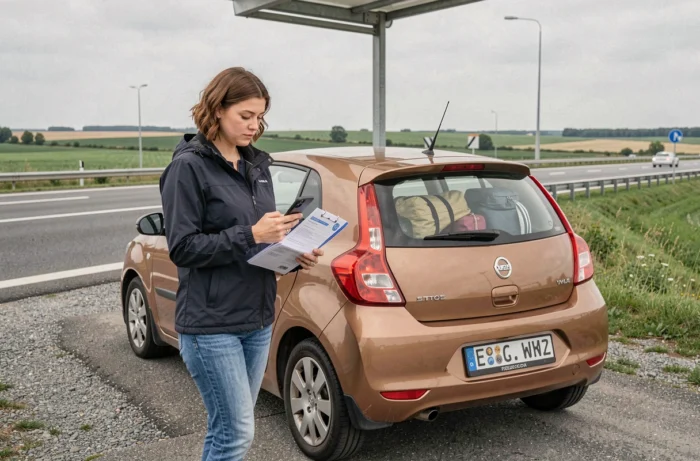
Poland massively imports German vehicles. The local market is full of Volkswagen, Opel, Audi, and Ford, often in trims and engines less common in France. It is on these models that the price difference is generally the most pronounced.
Why these brands in particular? The geographical proximity to Germany and the historical trade flows between the two countries create an abundant stock. A high volume of available vehicles mechanically drives prices down, especially for sedans and utility vehicles a few years old.
However, be cautious with high-mileage premium vehicles. A German sedan listed at an attractive price may hide heavy maintenance costs (timing belt, air suspension, onboard electronics). Before leaving, estimate the cost of parts and labor in France for the targeted model.
Securing the transaction on-site
Cash payment remains common in Poland for used vehicles. This payment method leaves no trace in case of dispute. Prefer a bank transfer with confirmation, which constitutes a legal proof usable in both countries.
Demand a written sales contract, even for a transaction between individuals. This document must mention the identities of both parties, the VIN, the price, the date, and the seller’s signature. Without a contract, the registration request in France will be blocked.
Also check that the vehicle is not encumbered by any lien or ongoing credit. In Poland, this information is not always easily accessible. A seller who refuses to provide these elements or who rushes the sale sends a clear signal.
Buying a car in Poland remains a profitable operation for those who are willing to prepare their file in advance. The price gap exists, but it only turns into real savings after mastering VAT, checking the vehicle’s history, and budgeting for each additional cost. The final gain depends as much on preparation as on the displayed price.