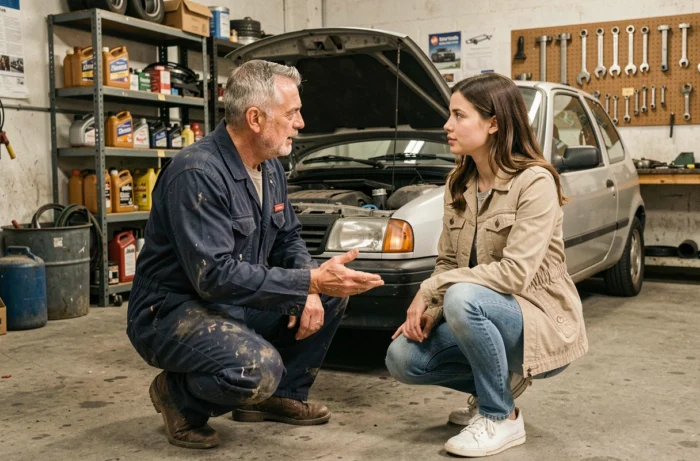
A delayed oil change, worn brake pads, a check engine light on for weeks: when the budget doesn’t allow, the car stays in the garage, or worse, drives in poor condition. Solidarity garages offer car repairs at reduced rates for people in financial difficulty. Their operation remains poorly understood, and the eligibility conditions vary from one organization to another.
Solidarity garage: an economic model different from traditional auto centers
A solidarity garage is not a low-cost garage. The difference lies in its status: it generally falls under the social and solidarity economy (SSE). In practical terms, the organization does not seek to make a profit. The margins on parts and labor are reduced to the strict minimum necessary to cover costs.
Labor costs less because these workshops often operate with employees in professional integration, supervised by qualified mechanics. The garage thus fulfills two missions simultaneously: restoring vehicles and training people distanced from employment.
The Solidarauto network exemplifies this model well. Present in several regions, it also collects cars donated by individuals, restores them, and then resells them at a moderate price. This automotive reuse circuit allows families to acquire a reliable vehicle without going through the traditional used car market. For more information on garage-solidaire-hainaut.fr, the services offered cover routine maintenance as well as more extensive repairs.
Eligibility conditions for repairs in a solidarity garage
Wondering if you can benefit from these reduced rates? The answer depends on your situation and the targeted garage. Most organizations require a referral from a social worker or a partner organization.
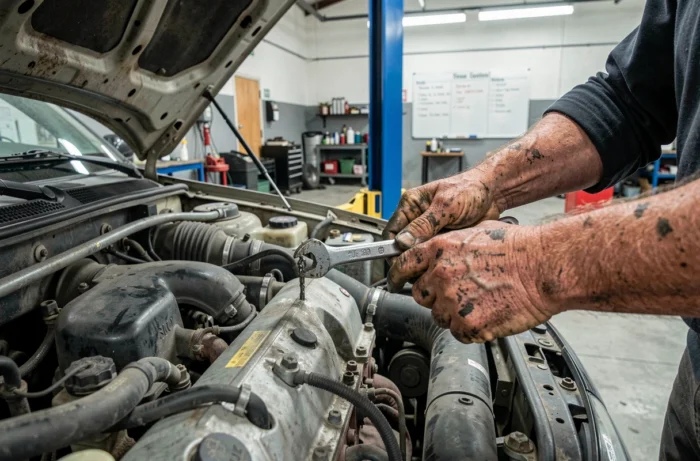
Generally accepted profiles include:
- Job seekers registered with France Travail, particularly those looking for long-term employment
- Beneficiaries of RSA or social minima, referred by a municipal social action center (CCAS)
- Scholarship students, sometimes through CROUS or local missions
- Temporary workers, who can access reduced-price repairs through FASTT (Social Action Fund for Temporary Work)
- Low-income retirees, referred by a social worker
Referral by a professional is often mandatory. In other words, you cannot always walk directly into the garage. A job counselor, a France Travail reference, or a social worker must validate your request. This filter ensures that available spots benefit those who need them most.
In Rhône, the Mobil’Aid platform goes further. It offers a comprehensive mobility diagnosis and can refer you to a solidarity garage, as well as assist in assembling a microcredit file to finance a vehicle or a driver’s license.
Services offered and limits to know
Solidarity garages cover routine maintenance and general mechanics. Oil changes, brake pad replacements, tire changes, battery checks, timing belts, clutches: the list resembles that of a traditional garage.
A detailed estimate is systematically provided before any intervention. This point deserves to be emphasized: price transparency is part of the solidarity model. No surprises at billing.
However, certain limits exist. Bodywork repairs are generally not covered, except for minor repairs on an exceptional basis. Waiting times may also be longer than in a traditional garage due to the limited number of workstations and the support for employees in integration.
ZFE: check before repairing
Before committing to an expensive repair on an older vehicle, ask yourself a practical question: will your car still be able to circulate in your usual area? ZFE restrictions vary from one metropolitan area to another (scope, hours, vehicle categories, exemptions). Despite sometimes contradictory national announcements, it is local authorities that set the effective rules.
A solidarity mechanic can help you assess whether the repair is worth the cost compared to the remaining regulatory lifespan of your vehicle in your area.
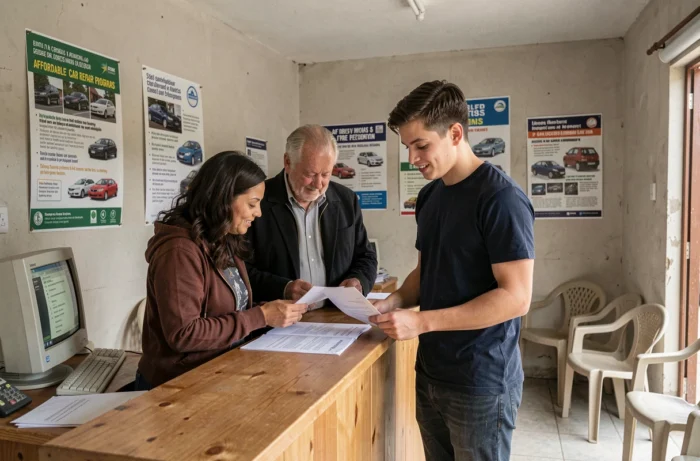
Finding a solidarity garage near you
The Solidarauto network has an interactive map on its website that lists its partner garages in France. However, not all solidarity garages are affiliated with this network. Some organizations operate independently, supported by local associations.
The first useful reflex is to contact your CCAS or local mission. These organizations are familiar with the available solidarity mobility schemes in your department. France Travail can also refer you to reduced-price repair solutions.
Some pointers for your search:
- CCAS and local missions have updated lists of partner garages
- FASTT references specific solutions for temporary workers, with a network of partners spread across the territory
- Inclusive mobility platforms (like Mobil’Aid in Rhône) combine diagnosis, referral, and financing assistance
The territorial coverage remains uneven. Large urban areas are better served than rural areas, where the car is often the only means of transport to access employment.
A solidarity garage does not solve everything, but it prevents having to choose between paying rent and repairing your car. For people in integration or precarious employment, keeping a vehicle in working order often conditions access to work. The system deserves to be better known, and especially better directed by social support professionals.