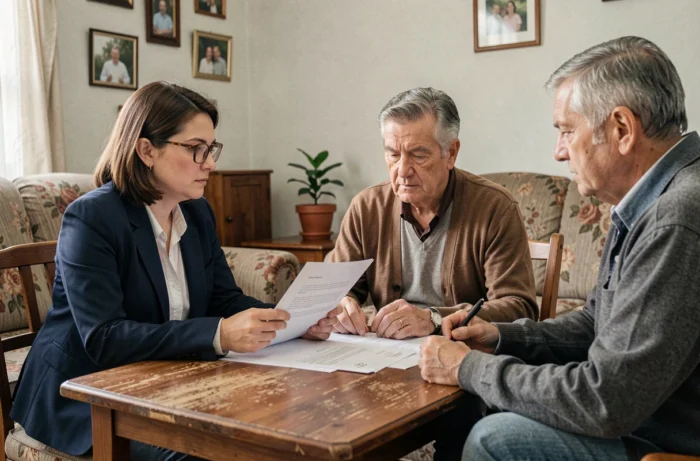
When a concern is raised or a report is received by the relevant services, an assessment process is set in motion. A social services investigation following a report is not limited to a single home visit: it involves several professionals, follows a specific regulatory framework and can lead to very different outcomes depending on the severity of the situation. Understanding the process helps families prepare for each step and know their rights.
Multidisciplinary assessment: the framework established by the 2022 law
Since the law of February 7, 2022, assessments of concerns about a child’s welfare have been based on a national framework established by the French National Authority for Health (Haute Autorité de santé). This framework structures the process to prevent disparities between departments. The assessment is therefore not left to the judgment of a single social worker.
The regulatory framework requires the assessment to be carried out by at least two professionals from different fields: social and educational services, healthcare, and psychology. This multidisciplinary approach explains why several people may visit the family in turn. Each observes the situation from a different perspective, then compares their findings with those of their colleagues.
The assessment does not focus solely on the child named in the report. It takes the wider family context into account, including the circumstances of any other children in the household. Discussions with professionals may therefore concern all the children in the family, not just the initial events that prompted the alert.
The process of a social services investigation following a report is based on this approach of bringing together different professional perspectives, which sets it apart from a simple administrative check.
Concern about a child’s welfare and a report to the prosecutor: two separate processes
It is common to confuse a concern about a child’s welfare with a report to the prosecutor. The two processes involve different people, timelines and consequences for the family.
| Criterion | Concern about a child’s welfare (IP) | Report to the prosecutor |
|---|---|---|
| Recipient | Cellule de Recueil des Informations Préoccupantes (CRIP) | Public Prosecutor |
| Level of danger | Potential danger or risk of danger | Serious or immediate danger |
| Type of assessment | Multidisciplinary social services assessment | Criminal investigation and/or referral to the juvenile court judge |
| Professionals involved | Social workers, psychologists, doctors | Judges, law enforcement, educational services |
| Possible outcome | Case closure, family support, referral to the courts | Immediate protective measure, placement, criminal prosecution |
The CRIP is the first point of review. It receives the alert, assesses it and decides whether a more in-depth assessment is needed. If the danger appears serious or immediate, the CRIP refers the case directly to the prosecutor without waiting for the assessment to be completed. The administrative process can therefore move into the judicial process at any time.
What the assessment involves for the family
Once the CRIP has validated the concern, professionals contact the family. The first step is generally a meeting at the family’s home, sometimes followed by meetings at the departmental service’s offices.
What professionals assess
The assessment looks at several aspects at the same time:
- The child’s material living conditions (housing, food, hygiene, access to healthcare)
- The quality of the relationship between the child and their parents, and the interactions observed in everyday life
- Parenting capacity and whether the parents recognize the child’s needs
- The family and social support network available to the household
Professionals do not simply note an isolated difficulty. They seek to determine whether the child’s physical, emotional or educational development is at risk.
Informing parents: the rule and the exception
As a rule, parents are informed when a concern about their child’s welfare is reported. Services must tell the family that an alert has been raised and that an assessment is underway. This transparency is intended to involve parents in finding solutions.
There is, however, an exception: parents may be informed later if doing so could compromise the child’s protection. In cases of serious abuse or domestic violence, notifying the parents before the assessment could increase the danger. This decision is made by the head of the service.
Possible outcomes after the social services investigation
The assessment results in a report that determines the next steps. There are three main possible outcomes.
If the assessment finds that there is no danger, the case is closed. The family is no longer monitored under this process, and no measures are taken. This is a common outcome and shows that the process also serves as a screening mechanism.
If difficulties are identified but there is no immediate danger, the family may be offered educational or social support with their consent. These are administrative measures, such as in-home educational support, parenting support or referral to specialist services. These measures cannot be imposed without the parents’ consent as long as the case remains within the administrative process.
If the danger is confirmed and the family refuses the proposed measures (or those measures are insufficient), the case is referred to the Public Prosecutor. The prosecutor may then refer it to the juvenile court judge, who has the authority to impose measures:
- Educational assistance in the home, with regular visits from an educator
- Placement of the child in a specialist facility or foster family
- Enhanced protective measures restricting parental rights
The juvenile court judge reviews the situation periodically. The aim remains to return the child to their family as soon as circumstances allow.

The social services investigation process is based on the principle of proportionality: each measure corresponds to the assessed level of danger, and the administrative process takes precedence as long as the family cooperates. For parents concerned, understanding how the process works can ease anxiety about the unknown and help them take an active part in the assessment rather than simply undergo it.