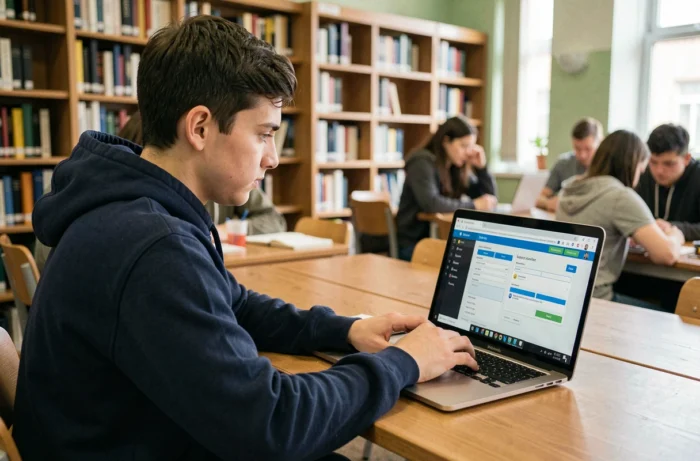
Esigelec, an engineering school with campuses in Rouen and Poitiers, will welcome more than 2,000 students for the 2025/2026 academic year, across its preparatory cycle, engineering cycle and master’s programs.
To manage student life for this population, the school provides an online e-service: a digital portal intended to centralize administrative and academic procedures. However, publicly available information about the tool’s exact scope remains limited, raising practical questions about what it actually allows students to do day to day.
Esigelec e-service: what official sources don’t explain
Most French engineering schools have a digital workspace (ENT) that provides access to grades, timetables, administrative documents and course materials. Esigelec’s e-service follows the same model, but its precise features have not been confirmed by an official school source in the available documents.
A help page about the e-service states that it was unable to verify which sections are accessible or whether they vary by user profile. In other words, there is no public confirmation of which sections are reserved for engineering students, teachers or administrative staff. This lack of documentation is more than a minor issue: students looking to plan their start-of-year procedures cannot find a comprehensive list of the services available on the portal.
By comparison, several universities and grandes écoles publish detailed user guides for their digital workspaces, complete with screenshots and video tutorials. This type of resource is missing from Esigelec’s public communications about its e-service.
A detailed article on Esigelec’s e-service for engineering students outlines what is known about the portal’s features and access requirements.

Logging in to the Esigelec e-service: an underestimated security issue
Access to an engineering school’s digital portal involves sensitive data: grade reports, internship agreements, personal contact details and, sometimes, financial documents related to tuition fees. Logging in is therefore about more than simply entering a username and password.
Available guidance on the Esigelec e-service emphasizes one precaution: always use the link provided by the school and check the URL before entering your login details. This basic advice for avoiding phishing suggests that the issue is relevant in a student context, although no incident specific to Esigelec has been documented.
For engineering students who log in every day from multiple devices (a campus computer, phone or tablet), a reliable authentication process is essential to the tool’s actual adoption. If a portal regularly fails to load or its URL is difficult to identify, students may turn to alternative channels: instant messaging groups, emailing documents to classmates or taking photos of noticeboards.
Mobile access: browser or dedicated app
Available sources indicate that the e-service can be accessed through a mobile browser, although its display or features may differ from the desktop version. No official mobile app has been confirmed in the available documents.
This distinction matters. A website accessed through a mobile browser generally offers a less seamless experience than a native app, particularly when quickly checking a timetable between classes or receiving real-time notifications. Schools that have developed a dedicated app report significantly higher usage rates than those with only a responsive web portal.
What to expect from a student portal at an engineering school
Although the exact contents of the Esigelec e-service are not documented in detail, the standard features of engineering school student portals give an idea of what such a service typically includes:
- Access to grades and assessment results, with a history by semester and course unit, allowing students to track their progress through the engineering program
- A real-time timetable showing room changes and cancellations, reducing the need to contact the administration
- Downloads of administrative documents (enrollment certificates, attestations and official transcripts) without having to go through the school office
- Access to course materials uploaded by teachers, project descriptions and practical assignment instructions
- Management of internship agreements and work-study documents—a particularly relevant feature, given that Esigelec welcomes around a hundred work-study students into its engineering cycle each year
The open question is how well these features are integrated. A portal that brings them all together in a single interface can genuinely simplify day-to-day life. A portal that redirects users to several separate systems (one for grades, another for timetables and a third for documents) fragments the experience and multiplies the number of passwords students need to remember.

The e-service and student life on the Rouen campus
Esigelec highlights its project-based teaching approach and active student association network. Initiative and Creativity projects, tutoring and associations focused on social engagement are all integral parts of the program. A well-designed e-service should logically support these activities too, with project registration, room bookings and communication between association members.
Esigelec engineering students follow a curriculum focused on intelligent, connected systems, covering digital technology, embedded systems, transport, energy and healthcare. The school’s digital portal could better reflect this specialization by incorporating collaborative tools suited to technical projects, such as code repositories, version tracking and shared workspaces.
Student feedback on day-to-day use of the e-service does not appear in the available public sources. Without these accounts, it is difficult to distinguish what the portal can theoretically do from what students actually use. A comprehensive but poorly designed tool may be widely bypassed, while a simple but reliable portal will be adopted without resistance.
The lack of detailed public documentation about Esigelec’s e-service does not mean the tool is faulty. It points to a communication gap that is a surprising blind spot for a school training engineers who specialize in connected systems.