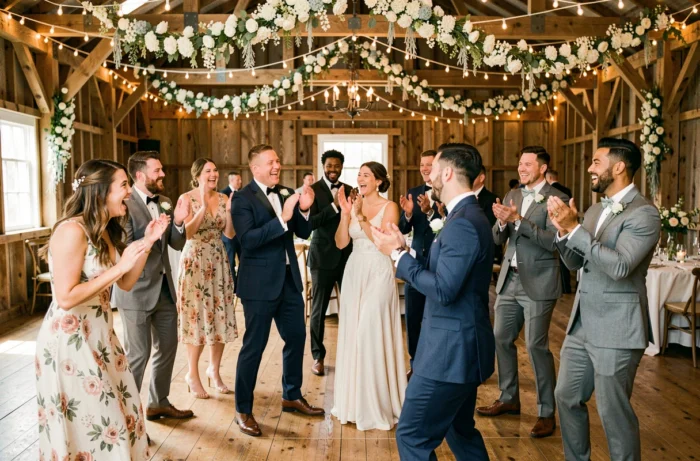
When comparing the most commonly booked wedding entertainment, a clear gap emerges between the activities that genuinely get everyone laughing and those that fade into the background all evening. Choosing original entertainment isn’t about ticking ideas off a list; it’s about finding the right combination of timing, interaction format and guest profile. This article examines that combination, drawing on vendor data and real-world feedback.
Comparing wedding entertainment by timing and interaction
Competitors often group entertainment by theme or type. The table below takes a different approach, matching each part of the wedding day with the level of guest involvement required to identify where lulls and energy peaks are most likely to occur.
| Timing | Passive entertainment (guests watch) | Semi-active entertainment (occasional participation) | Active entertainment (everyone takes part) |
|---|---|---|---|
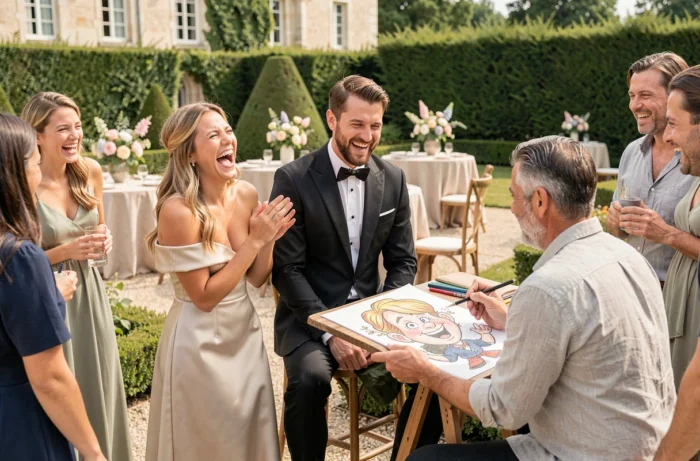
| Drinks reception | Live painter, acoustic musicians | Photo booth with props, fingerprint tree | Famous couples game, team escape game |
| Meal | Retrospective video, slideshow | Table-by-table music quiz, “her and him” quiz | Twelve-month game, inter-table challenges |
| Evening dancing | Fireworks, magic show | Hosted karaoke, custom song performed by the wedding party | Flash mob, dance battle, musical chairs with a twist |
Active entertainment generates the most laughter and shared memories. Passive entertainment, meanwhile, works better during transitions (as courses arrive or between two highlights). Alternating active and passive formats prevents guests from feeling overwhelmed while keeping the evening moving.
Among Party Wedding’s entertainment options, this alternating approach is built directly into the packages offered to couples, making it easier to plan the evening.
Active wedding entertainment: what really gets guests laughing
The “her and him” game is still the activity vendors most often cite as a surefire way to get everyone laughing. Its appeal lies in a simple setup: the newlyweds sit back to back, hold up signs, and every conflicting answer prompts an immediate reaction from the whole room.
A wedding escape game works differently. It brings together groups of guests who don’t know one another and gets them working together on a mission related to the couple (such as “finding the bride’s ring”). An escape game brings different groups of guests together better than any seating plan.
The twelve-month game, inspired by musical chairs, assigns forfeits to be completed throughout the year. It has a twofold effect: immediate laughter when the forfeit is assigned, followed by a lasting connection between the guests and the couple long after the celebration.
Three criteria distinguish entertainment that gets people laughing from an activity that falls flat:
- It lasts no more than about ten minutes. After that, attention wanes and guests lose interest, especially after the meal.
- The rules can be explained in one sentence. If the host has to repeat the instructions, half the room has already tuned out.
- Everyone can see the outcome, not just the participants. A game played in a closed circle leaves the rest of the room out.
Noise restrictions and the dance atmosphere: an often-overlooked factor
Getting guests dancing requires amplified music. French regulations govern sound levels at event venues, and local ordinances may set a cutoff time for music. Several community halls have faced repeated complaints from neighbors, as reported in the local press.
Check the venue’s noise limits before choosing musical entertainment to avoid having to turn the music off at midnight while the dance floor is still packed. In practice, ask the venue manager for three details: the maximum permitted sound level, the music cutoff time, and whether a built-in sound limiter is in place.
Dance activities (flash mobs, dance battles, choreographed first dances) depend directly on these restrictions. If the venue has a strict sound limiter, activities such as music quizzes or karaoke, which rely on short bursts of sound, are a better fit than a continuous, high-volume DJ set.
Wedding entertainment for children and adults: creating two atmospheres at once
Children often make up a sizeable group among the guests. Without a dedicated space, they may disrupt adult activities or get bored, leaving parents to keep them occupied and disrupting their evening.
The most effective solution is to create a separate, supervised space with age-appropriate activities:
- Face-painting or cupcake-decorating stations, which keep children occupied for a while without requiring constant supervision.
- Oversized board games (pick-up sticks, dominoes) set up outdoors if the venue allows.
- Coloring placemats at the children’s tables, which keep them busy independently from the start of the meal.
A well-planned children’s area gives parents the freedom to enjoy the games and dance floor. The cost is low compared with the impact it can have on the overall atmosphere of the evening.
Planning entertainment throughout the day: the pitfall of an overpacked schedule
Feedback from DJ-hosts points to one clear rule: no more than four activities across the entire day. Beyond that, guests feel overwhelmed, transitions come too quickly, and speeches by the wedding party get squeezed in.
The most reliable schedule includes one activity during the drinks reception (an active format to break the ice), one during the meal (a semi-active format that won’t interrupt service), and one or two in the evening (an active activity or a show). If the wedding party has planned any surprises, it’s best to keep them to around ten minutes and coordinate with the DJ and caterer in advance.
The wedding-weekend format, covered in recent American media, offers an alternative: spread activities over several days (a welcome party the day before, brunch the day after) rather than cramming everything into one evening. Spreading entertainment over two days takes pressure off the wedding-day schedule.
The final choice depends on the number of guests, the layout of the venue and the noise cutoff time. Couples who know these three details before choosing their entertainment can avoid most of the problems that might otherwise arise on the day.