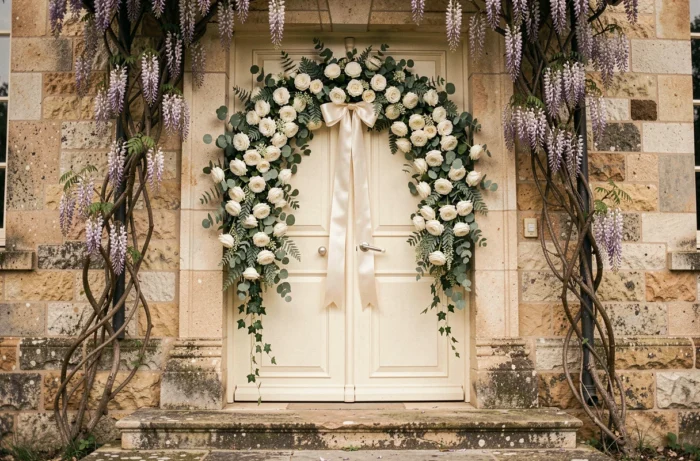
Decorating the entrance to a wedding venue is a balancing act: creating a strong first visual impression while preserving the functionality of a passage used by all guests, including those with reduced mobility.
At venues open to the public, regulations prohibit drapes hung across escape routes and require doors and passageways to remain clear for evacuation. These rules shape every decorative choice, from where to position a floral arch to how to attach a sheer curtain to the door frame.
Front door decorations and safety requirements for public venues
Most reception venues (castles, function halls, estates) are classified as establishments open to the public. Regulations prohibit textile or decorative elements that obstruct escape routes.
A foliage garland hanging in front of the door, a ribbon curtain attached to the lintel, a welcome sign placed in the middle of the passage: any of these common decorations could create a compliance issue if its position prevents the door from opening fully or reduces the width of the escape route.
Before planning anything, first ask the venue manager about the specific rules for the entrance. Some estates have a porch or canopy that provides decorative space away from the passage, while others have only a single door that opens directly onto the outside. The space available around the door determines what kind of decorations are possible.
A practical guide covering every option for decorating a front door for a wedding helps you visualize possible arrangements based on the shape and layout of the entrance.
Accessibility and wheelchair access for guests
Accessibility recommendations require a continuous, obstacle-free route, as well as clear, high-contrast signage. In practice, this means the welcome sign, floor-level floral arrangements, and lanterns must be placed outside the space needed to open and maneuver through the door. Keeping all decorations at least an arm’s length from the door greatly reduces the risk of obstruction.
Specific rules vary depending on the venue and its classification, but the principle remains the same: decorations should frame the entrance, not encroach on it.
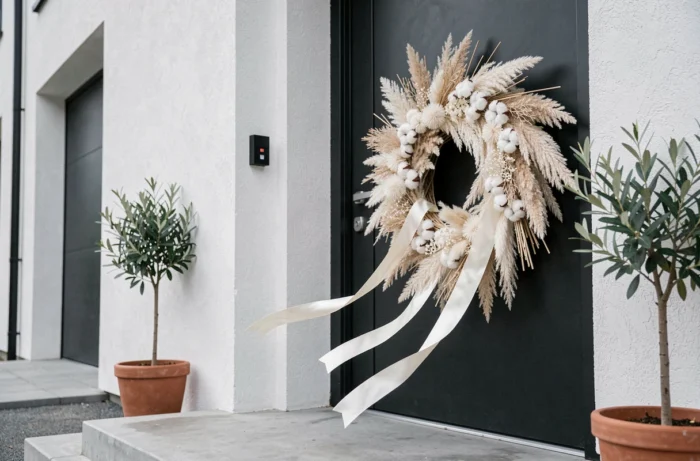
Floral door arrangements: seasonality and reuse
Choosing flowers for a wedding entrance is about more than aesthetics. A recent floral guide recommends selecting varieties based on their actual availability on the wedding date, then confirming which flowers will be available as the event approaches.
A peony planned for a June wedding may not be available if the season runs late. For a door arrangement, it’s better to plan a color palette than rely on a single variety.
Identifying three or four alternative varieties in advance helps avoid floral disappointment on the big day. A florist experienced in weddings will usually suggest this approach, but asking for it explicitly when requesting a quote helps prevent unpleasant surprises.
Reuse the entrance arrangement for the cocktail reception
A door decoration can be designed from the outset to move to another area after the ceremony. The approach, recommended in professional floral guides, is to decide in advance who will move the arrangement (coordinator, wedding party member, or vendor) and choose a stand that works in both locations.
- A freestanding arch placed in front of the door can be moved to the seating chart or cocktail reception entrance without any changes
- Two urn arrangements framing the entrance can become buffet centerpieces after the ceremony
- A welcome sign on an easel can be moved to the photo area in seconds
Mobile decorations reduce the overall floral budget and prevent waste from a one-time installation.
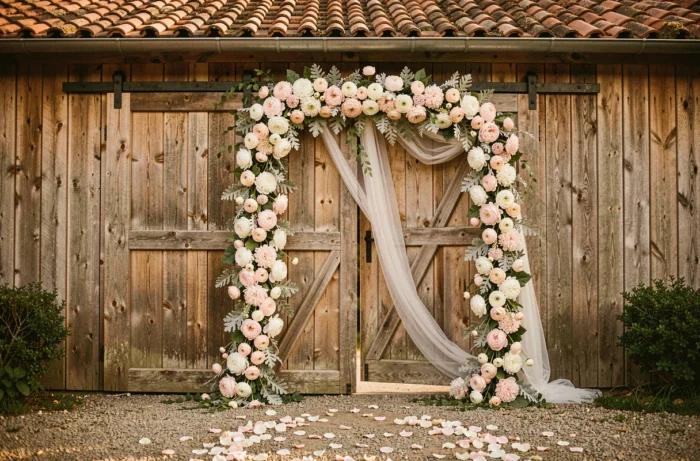
Decorating a wedding door without drilling or gluing
Reception venues often prohibit fixtures that could damage woodwork, especially on historic or listed doors. Several techniques can help you work around this restriction without compromising the visual impact.
Removable over-the-door hooks, which hang over the top of the door without drilling, can hold a floral wreath or fabric bow. Fishing line stretched between two existing points (such as a handle and hinge) can be used to suspend a greenery garland along the door frame without touching the stone or wood.
- Suction-cup hooks work on smooth surfaces (glass, painted metal) but may come loose in high heat or on porous surfaces such as rough stone
- Raffia-wrapped wire tied around the hinges can support lightweight arrangements without marking the metalwork
- Freestanding supports (easels, tripods, arches on weighted bases) eliminate any contact with the door itself
The right method depends on the door material and the venue’s requirements. Ask the venue manager for a detailed photo of the entrance before buying anything to avoid unnecessary purchases.
Which materials create an elegant look?
Lightweight fabrics (organza, fine linen, chiffon) add movement and filter the light without weighing down the structure. Attached to the side frames rather than stretched across the passage, they frame the door without preventing it from opening. Preserved foliage (eucalyptus, olive branches) offers a natural look that withstands heat and wind, unlike fresh flowers exposed to direct sunlight, which can wilt within hours.
For a winter wedding, arrangements of dried branches, berries, and LED candles in glass votives add visual warmth. Avoiding open flames right next to a door is a basic precaution at a venue open to the public.
Wedding door decorations work best when treated as both a photo backdrop and a welcoming feature: guests stop, pose, and then move on. Keeping these two functions in mind—visual appeal and smooth traffic flow—helps guide every decision toward a result that is both elegant and practical.