
An operator reports a slippery floor near a storage area. The next day, a colleague notes that a cable tray is loose in the same area. Observations collected during a risk hunt only have value if they lead to documented corrective actions. Workplace prevention relies on this process: turning what employees see every day into concrete measures that are documented and monitored over time.
The risk hunt, as promoted by INRS, provides a framework for this approach. You walk through a workshop, warehouse or office with a critical eye, identify hazardous situations and record them. The real challenge starts afterward: what do you do with the list?
INRS risk hunt: from the workplace to the single risk assessment document
On paper, a risk hunt looks like an awareness-raising exercise. You hand out a checklist, ask teams to spot what is wrong, then review their findings. In practice, the exercise only delivers lasting results if it feeds directly into the Single Document for the Assessment of Occupational Risks (DUERP).
The DUERP is not a static document. It must be updated at least once a year in companies with more than eleven employees, and whenever working conditions change significantly. The risk hunt provides the raw material for this update: observations dated and localized, and reported by the people exposed to the risks.
You can use the INRS risk hunt to structure this data collection using a repeatable method that can be applied in any industry.
A common pitfall is to organize a risk hunt once a year, fill in a spreadsheet, then file it away without taking any further action. The observations then remain a training exercise with no impact on actual working conditions.
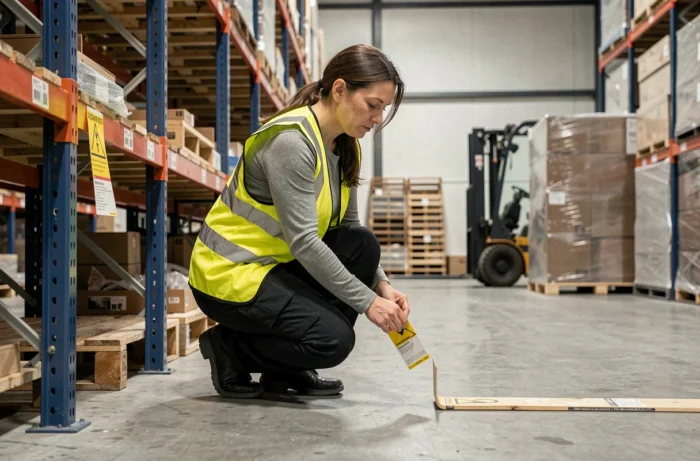
Linking workplace observations to concrete prevention measures
The challenge is not spotting risks. Any experienced employee can point out inadequate lighting, an electrical cabinet left open or a poorly arranged workstation. The challenge is turning each observation into an assigned, budgeted and scheduled action.
Prioritize based on severity and frequency of exposure
Not all hazardous situations need to be addressed within the same timeframe. Rank observations according to two criteria: the potential severity of harm to health and how often employees are exposed. A serious risk that occurs frequently takes absolute priority.
Even a basic risk rating helps prevent resources from being spread too thin. Replacing a faulty light in a rarely used corridor can wait. Securing a traffic area where forklifts and pedestrians cross paths several times an hour cannot.
Set out the action plan with an owner and a deadline
Every risk identified during the hunt should be assigned three things:
- A named owner responsible for implementing the corrective measure (not simply “the maintenance department”)
- A realistic deadline that reflects the risk’s assigned priority
- A monitoring indicator to check that the measure has been implemented and is producing the expected results
Without these three elements, the action plan is just a wish list. Companies regularly document dozens of risks without ever completing the corrective action cycle.
Workplace prevention training: involving employees beyond the exercise
Risk hunts work best when participants understand the general principles of prevention. INRS defines nine, including avoiding risks, assessing those that cannot be avoided, and tackling risks at their source. These principles are not abstract: they guide practical decisions.
Tackling a risk at its source might mean replacing a hazardous chemical with a less harmful alternative, rather than handing out masks. Training teams to think this way changes how they approach the hunt. They no longer just list visible issues; they question the way work itself is organized.
One point that purely technical approaches overlook: trained employees spot risks that management does not see. An operator who uses a machine eight hours a day knows its faults better than the safety manager who visits once a month. Making the most of this on-the-ground expertise means creating a permanent reporting channel, not relying solely on scheduled exercises.

DUERP and risk hunts: maintaining traceability over time
The DUERP serves as evidence in the event of a labor inspectorate audit or legal proceedings following an accident. Its quality depends directly on how rigorously the results of risk hunts are incorporated into it.
In practice, each risk hunt should result in an appendix to or update of the DUERP, including:
- The date and scope of the exercise (the workshop, floor or production line covered)
- A list of participants, including representatives of employees exposed to the risks
- The risks identified, their ratings and the measures decided upon
- The status of actions as of the next update
This level of traceability distinguishes a structured prevention approach from a simple awareness-raising workshop. The DUERP becomes a living document, informed by what happens on the ground, rather than an administrative form completed just to meet an obligation.
How often to conduct a risk hunt depends on the size of the company, the nature of its activities and staff turnover. In an industrial environment where jobs change frequently, a campaign every six months is better at covering new risks than a one-off annual exercise.
Workplace prevention is about more than ticking regulatory boxes. When employees’ observations are taken seriously, documented and followed up, the risk hunt stops being a one-off exercise. It becomes the foundation of a safety culture in which every report from the workplace has a real chance of improving working conditions.