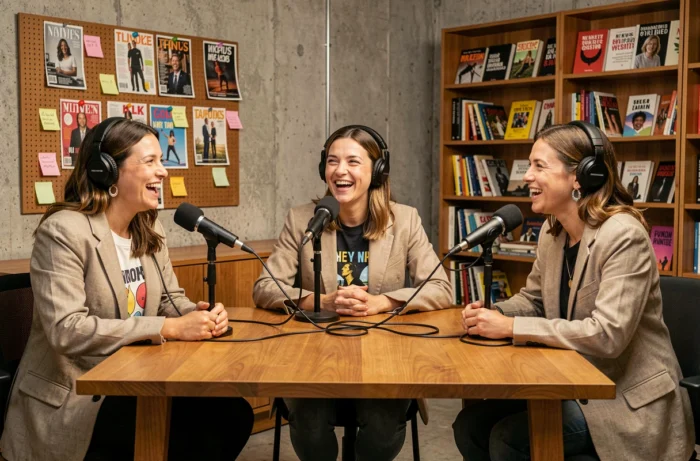
Quoi de Meuf is a French-language feminist podcast rooted in pop culture. Over several seasons, it brought together political analysis, cultural criticism, and conversations about the body, sexuality, and mental health. Its end did not erase the community it had built, and it is worth asking precisely what remains of it.
Quoi de Meuf’s editorial approach: cultural criticism in the service of feminism
Each episode started with a specific cultural subject—a film, a TV series, a music video, or a viral phenomenon—and used it as a springboard for well-researched feminist analysis. The podcast was not an opinion talk show. It was a work of applied cultural criticism, featuring guests selected for their knowledge of the subject at hand.
This approach clearly set it apart from other women’s or feminist shows of the same period. While most formats focused on personal testimony or general-interest debate, Quoi de Meuf built each episode around a single thematic angle, explored in depth over an extended runtime.
The topics covered a broad range: the representation of women in French cinema, the politicization of mental health, relationships with our bodies, and the deconstruction of dress codes. Quand Je Serai Grande’s article on Quoi de Meuf.net examines this approach through the lens of a women’s media outlet that breaks with the usual lifestyle conventions.
The podcast benefited from polished sound production and professional distribution through major platforms (Apple Podcasts, Spotify), giving it broad visibility among French-speaking audiences.

The Quoi de Meuf community after the show ended: where to find the episodes and conversations
All Quoi de Meuf episodes remain available online. Major podcast platforms retain the complete catalog, which can be replayed without any time limit.
The community that formed around the podcast did not disappear when production ended. It spread across several spaces:
- The podcast’s social media accounts (particularly Instagram), where older posts continue to spark engagement and listeners still share episodes
- Other French-language feminist podcasts that carry forward themes explored by Quoi de Meuf, such as mental health, everyday sexism, and social justice
- French-language feminist newsletters, including the one Quoi de Meuf launched to bring feminism and pop culture together—a format praised by media outlets such as Trois Couleurs
What remains is not a centralized community but a network of shared references. Episodes still circulate as educational resources in activist, academic, and cultural circles.
Feminist editorial approach: Quoi de Meuf’s contribution to French-language podcasting
Quoi de Meuf’s editorial model left its mark on a generation of French-language feminist podcasts. Its approach of cultural analysis with a political purpose, without condescending oversimplification, became a touchstone for shows that followed. Several adopted this framework, bringing pop culture and feminist thought together for an audience that cares as much about substance as style.
Before this podcast, French-language feminist audio content fell into two categories: intimate personal testimony and activist manifestos. Quoi de Meuf opened up a third path: engaged cultural criticism, requiring expertise in both media analysis and feminist theory. This approach broadened the range of formats available to French-speaking listeners.
The podcast also showed that a women’s media outlet could thrive without a beauty section or shopping content. No product picks, no partnerships with cosmetics brands, no seasonal buying guides. Its audience was not monetized through consumerist aspiration.

Long-form content in an age of fragmented attention
Quoi de Meuf embraced a long-form format, going against the trend toward shorter episodes that was already taking hold in the French podcast market. The extended runtime gave guests time to develop their arguments and avoided reducing complex subjects to sound bites.
This approach required a loyal audience willing to set aside time to listen each week. The podcast’s run across several seasons confirms that such an audience existed and kept coming back.
Quoi de Meuf’s legacy in online feminist media
The end of production did not leave a clear editorial void. The French-language feminist podcast landscape has grown since Quoi de Meuf first launched, and several recent shows continue to explore themes the podcast brought into the audio conversation: the politicization of mental health, the deconstruction of gendered representations, and criticism of sexism in the cultural industries.
Its distinctive feature was the consistent connection between pop culture and feminism. Few current podcasts maintain this dual focus with the same rigor. Most choose a single angle—personal testimony, current affairs, or a social issue—without combining it as methodically with cultural analysis.
The archived episodes remain relevant beyond the context in which they were first released. A structural analysis of the representation of women’s bodies in cinema does not become outdated at the same pace as a current-affairs topic.
Quoi de Meuf showed that a French-language feminist podcast could run for several seasons without compromising on analytical rigor. The episodes remain online, the community has moved on without dissolving, and the format it established continues to serve as a reference point for many French-language feminist productions.