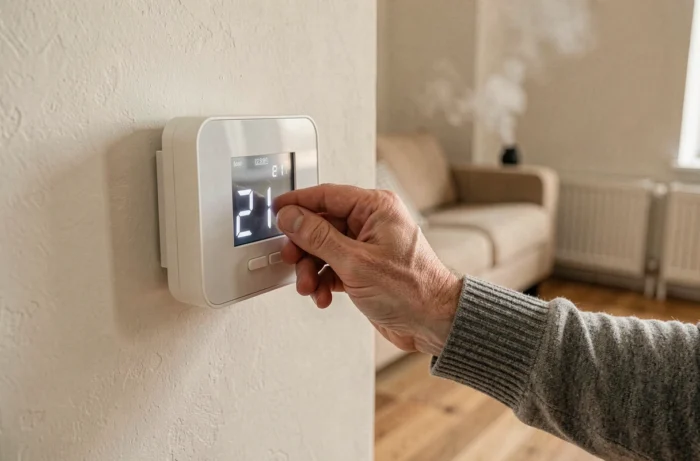
The thermostat displays 21 °C, the set temperature has been reached, and yet the boiler keeps running. This surprises many homeowners, especially when their gas bill is climbing for no apparent reason. The good news is that, in most cases, this is normal. To understand why, it helps to take a closer look at what happens between the thermostat, the boiler and the walls of your home.
Boiler modulation: running doesn’t mean overheating
Have you ever noticed that a car doesn’t accelerate at full throttle going downhill, even though its engine is still running? A modern boiler works on the same principle. When the room temperature approaches or reaches the set point, the boiler doesn’t shut off abruptly. It reduces its output to a minimum.
This mechanism is called modulation. Instead of switching between full power and a complete shutdown, the boiler adjusts its flame to maintain the temperature smoothly. The burner stays on, but at a very low output. Buderis also notes that a boiler may continue running after the set point has been reached because it is in modulation mode.
To better understand how this works, the explanation of a thermostat reading 21 °C outlines the difference between shutting off the burner completely and simply reducing its output.
This is preferable to repeated on-off cycles. Every restart puts strain on the boiler’s components and uses a surge of energy. A burner modulating at low output uses less energy than one that shuts off and restarts ten times an hour. Continuous operation at a low flame is therefore often a sign that the controls are working properly.
Thermostat reading 21 °C: the measurement isn’t always accurate
The thermostat measures the temperature in just one spot. If that spot gets direct sunlight in the late afternoon, is near a radiator or is in a hallway exposed to drafts, the reading may not reflect the actual room temperature. The sensor may show 21 °C while the center of the living room is still at 19.5 °C.
The regulatory reference temperature is measured in the center of the room, 1.5 m above the floor. Your thermostat, however, is often mounted on a wall—sometimes high up, sometimes near a door. Placing it just a few metres away can skew the reading by one or two degrees.
The boiler also receives information from the water flow temperature sensor. If the water returning from the radiators is still cool, the control system assumes the home hasn’t reached a stable temperature, even if the thermostat says otherwise. The burner therefore keeps running to make up the difference.
What to check about your thermostat’s location
- The thermostat should not be exposed to direct sunlight, even for just a few hours a day. Sunlight hitting the sensor can make it register the room as warmer than it really is.
- It should not be above or next to a radiator, or behind furniture that blocks airflow around the sensor.
- It should be about 1.5 m above the floor, on an interior wall in the main living area. A thermostat in the hallway measures the hallway temperature, not the living room temperature.
A boiler that’s too powerful for your home: a common problem
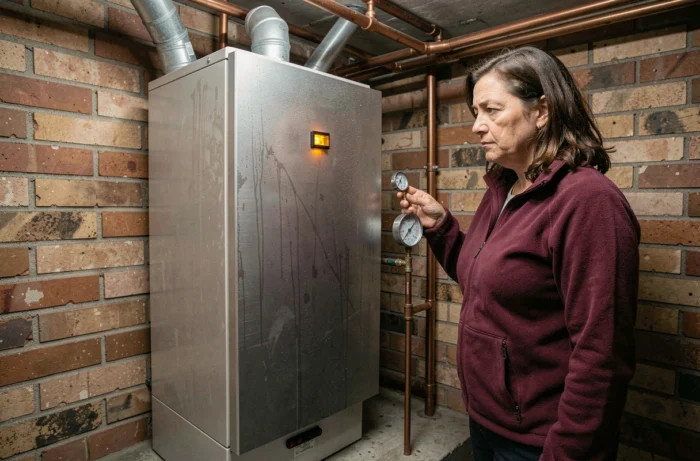
Modulation has its limits. If a boiler’s minimum output is still too high for the home’s actual heating needs, it won’t be able to turn down far enough. It will keep producing more heat than necessary, even while modulating.
This oversizing is common. During installation, the boiler’s output is sometimes calculated with a generous safety margin, or the boiler may have been chosen before the home was insulated. After insulation work (in the attic, windows or walls), heating needs decrease, but the boiler stays the same.
An oversized boiler modulates poorly and wears out faster. The burner switches between its minimum output and frequent shutdowns, cancelling out the benefits of modulation. If your boiler stops and restarts every few minutes instead of running continuously at a low output, oversizing is a strong possibility.
Controls and programmable thermostats: what the regulations require
French regulations on thermostats are evolving. The requirement is to install programmable controls with settings such as comfort, reduced, frost protection and off. A smart thermostat that can be controlled by smartphone is not mandatory: what matters is the programming function.
There are technical exceptions. The requirement does not apply if installing a programmable thermostat is technically impossible, or if the payback period exceeds ten years (as demonstrated by a study).
If your current thermostat is an on-off model (it sends a heating or shutdown signal with no intermediate settings), it won’t let the boiler modulate. The boiler is told either to heat at full power or to shut off. Switching to a modulating thermostat allows the boiler to reduce its output instead of shutting down. The continuous operation you’re noticing may then stop, replaced by quieter, more energy-efficient modulation.
When to contact a professional
- The room temperature rises well above the set point (22 °C, 23 °C or more) while the boiler continues heating at full power: this is more than simple modulation.
- The boiler stops and restarts very frequently instead of running continuously at a low output: the thermostat or communication between the equipment may be the cause.
- The radiators remain extremely hot even when the thermostat has reached its set point: a problem with a valve, circulator or water flow temperature should be investigated.
A heating engineer can check the heating curve, thermostat and boiler compatibility, and adjust the minimum modulation output. These settings are rarely accessible without technical training, and incorrect adjustments can increase energy consumption rather than reduce it.
A boiler running at low output when the thermostat reads 21 °C is usually doing what it’s supposed to. The real warning sign isn’t the sound of the burner—it’s the temperature continuing to rise beyond the set point.