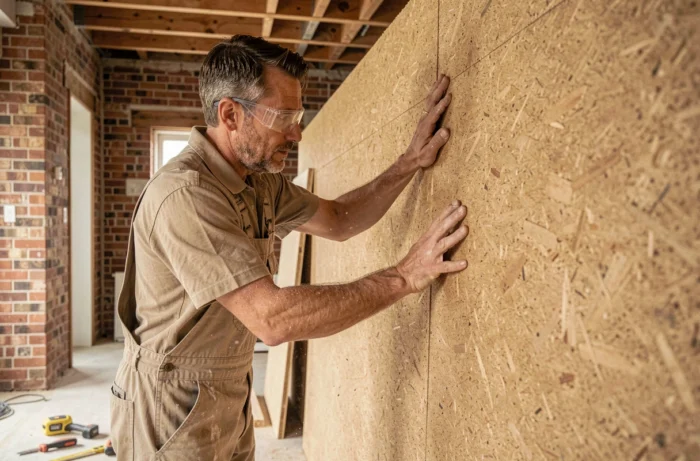
Choosing an interior wall finish for a renovation involves more than comparing product specifications. Before selecting an alternative to plasterboard, assessing the existing substrate is essential: the type of wall, residual moisture levels, surface evenness and room ventilation all matter. Skipping this step means covering an old problem with a new material.
Assessing the substrate before replacing plasterboard: moisture, ventilation and compatibility
On an old stone or solid-brick wall, changing the board will not solve a damp patch. Lateral water ingress, rising damp and inadequate drying after building work each require a different technical solution. Moisture must be assessed before choosing a wall finish; otherwise, the new covering may deteriorate within a few seasons.
We find that comparison articles often overlook insulation continuity at junctions: window connections, floor corners and service penetrations. Even a high-performance board installed on a poorly sealed frame can leave thermal bridges that cancel out the expected gains. Room ventilation should also be reassessed: installing a finish that is less vapour-permeable than the original without adjusting air exchange creates a risk of condensation within the wall.
It is therefore worth considering these site-specific factors before comparing materials when choosing from the alternatives to plasterboard for your renovations.
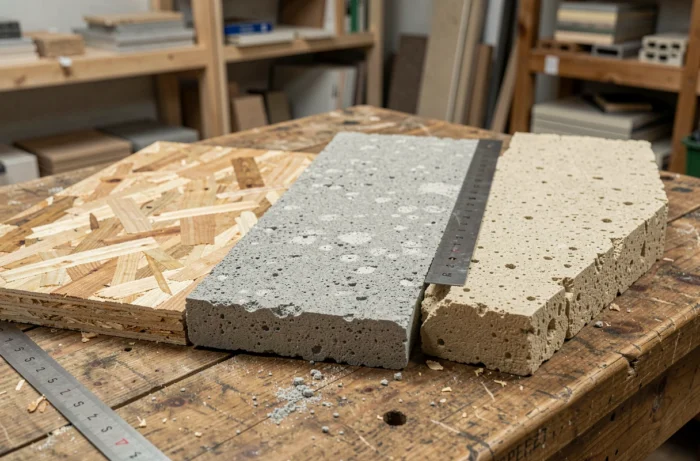
Fermacell gypsum fibreboard vs. high-density boards: two approaches to mechanical strength
Fermacell (gypsum and cellulose) and high-density plasterboard such as Habito address the same common criticism of standard 12.5 mm plasterboard: its susceptibility to impact damage and the difficulty of securing heavy items. However, their structural properties differ.
Fermacell: cellulose fibres integrated throughout the board
Gypsum fibreboard incorporates recycled cellulose fibres directly into the gypsum, distributing strength throughout the board. Screws can be driven directly into it without wall plugs, supporting significantly heavier loads than standard plasterboard. Its harder surface also stands up better to everyday knocks.
Fermacell does not require joint tape: a simple filler is enough at the joints, eliminating the most time-consuming and messiest step of traditional plasterboard installation. The trade-off is that the board is heavier and harder to cut with a utility knife.
High-density boards (Habito): a reinforced plaster core
Habito retains the paper-faced plasterboard design but uses a denser core and reinforced facing. Screws provide a reliable fixing for medium-weight loads. Its main advantage is direct compatibility with standard plasterboard framing systems and accessories, making the switch straightforward for installers used to standard 12.5 mm plasterboard.
The difference becomes clear on site: Fermacell requires suitable tools (a circular saw and router), while Habito can be worked with standard plasterboard tools.
Wood and wood-fibre panels: insulation, structure and hygrothermal performance
OSB and wood-fibre panels serve different purposes, which comparison articles often conflate.
- OSB (oriented strand board) offers high mechanical strength and is used for bracing timber structures. However, it provides little insulation and is vulnerable to prolonged exposure to moisture. As a finish, it suits industrial-style interiors but needs a protective treatment or stain in damp rooms.
- Rigid wood-fibre panels combine thermal insulation with humidity regulation. Their density also provides useful thermal lag in summer. They can be installed as bonded internal insulation or on a frame, with a finishing coat or an additional wall covering.
- Solid-wood panelling (pine, spruce or poplar) provides a ready-to-use finish that requires no plaster or paint. Installing it on battens creates an air gap that helps ventilate the back of the wall—an advantage when renovating older buildings.
For bio-based materials, checking environmental declarations is just as important as checking where the product comes from. An FDES (Environmental and Health Declaration) available on the INIES database is the only standardised document for comparing the carbon impact of two panels.
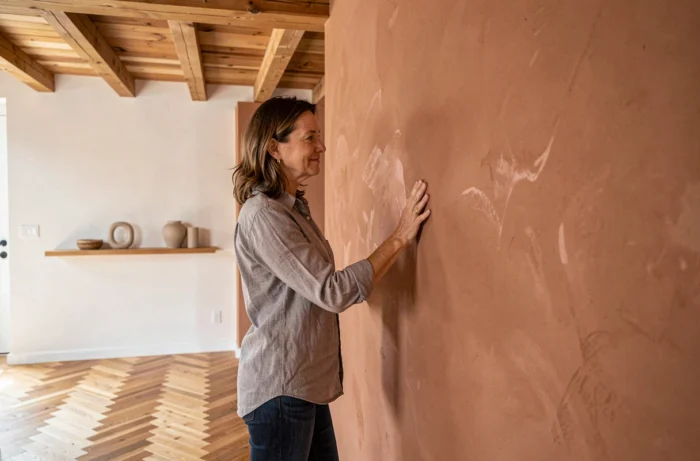
Interior finishes for old walls: lime, clay and spray-applied plaster
When the load-bearing wall is sound and sufficiently even, applying plaster directly avoids the need for a frame and preserves the wall’s thermal mass. Three types are particularly suited to renovation.
Lime plaster is the most compatible finish for traditional masonry (stone, brick and cob). Its water-vapour permeability allows the wall to breathe, helping limit moisture-related problems. Applying it in several coats requires skilled workmanship and long drying times between coats.
Clay plaster (clay and sand) is similarly vapour-permeable and also provides measurable humidity regulation in living spaces. Its surface is not very durable, so it is unsuitable for high-traffic areas without a protective finish.
Mechanically spray-applied plaster can cover large areas quickly and create a smooth finish. It is suitable for sound substrates but does not tolerate moisture well, ruling it out for wet rooms and walls affected by rising damp.
How to choose based on the room and wall type
The right material depends less on its inherent qualities than on how well it suits the conditions on site.
- Wet rooms (bathrooms, kitchens): choose moisture-resistant boards (Fermacell HD or moisture-resistant plasterboard) or a lime-cement render. Avoid untreated OSB and clay plaster unless they have specific protection.
- Old stone walls with residual moisture: a vapour-permeable finish (lime or clay) protects the masonry better than a framed lining, which can trap moisture between the wall and the finish.
- Partition walls in a modern home: Fermacell or Habito can replace standard plasterboard without altering the existing metal frame, providing an immediate improvement in mechanical strength.
- Converted lofts: wood-fibre panels used as insulated lining combine the finish and insulation in a single layer, freeing up a few valuable centimetres beneath the roof slope.
Replacing plasterboard only makes sense if the chosen material addresses the problem identified with the existing wall. Fermacell installed on an untreated damp wall will perform no better than standard plasterboard. Each alternative has its own installation requirements, and these—not the product specification sheet—are what determine how long the result will last.