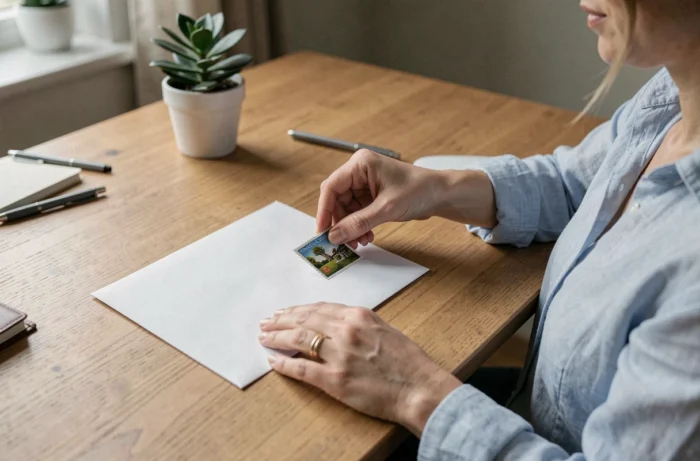
You prepare an official letter, slip the document into the envelope, quickly stick on a stamp, and three days later it comes back. The problem is almost never the address: it’s the stamp, incorrectly positioned or insufficient, that disrupts automated sorting. Knowing exactly where to place your postage avoids this kind of return and saves you a few euros.
Optical scanning area: why machine sorting dictates where to place the stamp
La Poste sorting centers use optical readers that scan each envelope in a fraction of a second. The machine first identifies the postage area, then the recipient’s address, and finally the postal code. If the stamp overlaps the area reserved for the address or is placed at the bottom of the envelope, the item is diverted for manual processing.
Manual processing slows delivery. In some cases, the mail is returned to the sender marked “insufficient postage”. That’s why knowing where to put a stamp on an envelope is no trivial detail—it’s essential for ensuring your mail reaches its destination.
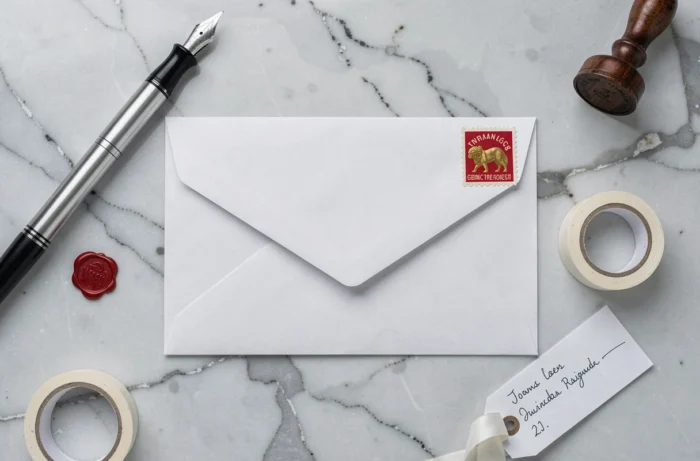
Always stick the stamp in the top-right corner of the envelope. This rule applies to letters, postcards, and letter-format mail. Leave the area to the left of the stamp clear: La Poste places its cancellation mark there to show the mailing date and prevent the stamp from being reused.

Stamp in the wrong place on an envelope: the real risks
Sticking a stamp on the left, in the center, or at the bottom of the envelope doesn’t always result in the mail being returned. But the chances of normal delivery drop. The item is sent for manual processing, which can add one or more days to delivery time.
The most significant risk concerns registered mail or official correspondence with a legal deadline. A delivery delay caused by a misplaced stamp could mean missing a deadline. In that case, La Poste is not liable: responsibility for non-compliant postage rests with the sender.
Insufficient postage: a fee charged to the recipient
A correctly placed stamp with too low a value creates a different problem. La Poste may deliver the item to the recipient and ask them to pay the shortfall, plus a handling fee. If the recipient refuses to pay, the amount may be charged to the sender.
This often happens with slightly thicker envelopes (containing several sheets or a small rigid item) that exceed the basic weight bracket. Checking the applicable rate before sending helps avoid this unpleasant surprise.
Multiple stamps and non-standard envelopes: cases that can cause problems
When one stamp isn’t enough, you can use several. The rule stays the same: place all stamps in the top-right corner, side by side or stacked vertically. Avoid spreading them across the envelope, as the sorting machine may not detect them all.
The same rule applies to long or square envelopes: the top-right corner remains the postage area. However, with custom envelopes featuring a logo or printed design, make sure the stamp doesn’t overlap any graphic elements. Printed elements too close to the postage or address area can interfere with optical scanning, even when the stamp is correctly positioned.
Checklist before mailing an envelope
- The stamp is stuck flat in the top-right corner, without extending over the edge or partially covering the address
- The recipient’s address is legible and written or printed in the lower-right half of the envelope, with the postal code and city on the last line
- The sender’s address is on the back of the envelope (or in the top-left corner on the front) so the item can be returned if there’s a problem
- The postage value matches the actual weight of the item, not just the estimated number of sheets
- No graphic elements overlap the stamp area or the postal-code scanning area
Stamps printed online: validity and pitfalls to know
Stamps bought online and printed at home follow the same placement rules. But they come with an additional consideration: a printed stamp may have a limited validity period. Before reusing an online stamp that you’ve kept for several months, check its expiry date on the La Poste website.
A printed stamp must never be photocopied. La Poste treats counterfeit postage as fraud and may stop processing the item. This is a separate risk from incorrect placement, but the result is the same: the mail doesn’t arrive.
Digital stamps via smartphone
La Poste also offers a digital stamp generated by SMS or through its mobile app. You receive a code to write directly on the envelope, in the usual stamp position (top right). This code replaces a physical stamp but must be placed in the same area so sorting machines can read it.
Stamp placement on an envelope follows an industrial logic, not an arbitrary convention. Top-right corner, flat, with no overlap with the address or a printed design. Using this area ensures smooth automated sorting and delivery within the timeframes announced by La Poste.