
Straight-leg jeans, a plain T-shirt, white sneakers. The basics are clean, but they don’t say much. Add a braided belt, a short-tied scarf and a watch with a large dial, and the same outfit suddenly has a point of view. Fashion accessories don’t just decorate—they shape how an outfit is perceived.
Charms and customization: update a bag instead of buying another
The most practical trend right now isn’t about accumulating more pieces, but transforming the ones you already own. Removable charms—small ornaments attached to a bag, a zipper or a shoe buckle—let you change an accessory’s character without replacing it.
Brands such as Coach and Martha Calvo have popularized this approach, which nss France calls “chaotic customization.” The idea is simple: the same bag can go from understated to statement-making depending on the pendants, trinkets or costume jewelry you hang from it. You can also repurpose old jewelry, an inherited medallion or a forgotten brooch, attaching it to a handle for a one-of-a-kind effect.
What makes this approach appealing is that it works with any budget. A brass charm found at a flea market can make just as much of a visual impact as a designer pendant, as long as you play up the contrast with the bag.
A raw-canvas tote gains personality with two or three metal charms, while a structured black leather bag works best with a single, well-placed detail. To explore pieces that lend themselves to these kinds of combinations, Blog 2 Mode’s accessories offer a practical starting point.

Belts and scarves: two fashion accessories that reshape an outfit
The structuring effect of a belt worn over a loose-fitting piece is often underestimated. Cinch an oversized blazer at the waist with a slim leather belt, and you redefine the silhouette without altering the garment. Wear the same blazer open and without a belt, and it sends a very different message: more relaxed and less polished.
A belt acts like a dividing line. On a flowing dress, it creates a visual anchor that draws the eye. With a suit, a textured belt—braided, suede or with a distinctive buckle—adds interest in place of a plain black style without veering into eccentricity.
The scarf as a styling wildcard
The scarf is the most versatile and least-used accessory. Tied around the neck, it adds a pop of color without competing with the rest of the outfit. Worn as a headband, it changes the proportions of the face. Tied to a bag handle, it follows the customization approach mentioned above.
A square silk scarf can be tied in more than ten different ways. One purchase, multiple looks. The key is to choose a scarf that contrasts with the outfit’s dominant color rather than repeating it. A navy scarf on a navy sweater disappears. An ochre scarf on the same sweater creates a focal point.
Shoes and bags: the accessories that have the biggest impact on how a look is perceived
When you see someone on the street, your eyes go first to their face, then down to their feet. Shoes set the tone before you even take in the rest of the outfit. A pair of leather loafers with raw denim projects a different image from technical sneakers worn with the same jeans.
- Pointed-toe shoes visually elongate the silhouette and give an outfit a more formal feel, even when worn with casual chinos.
- Block-heel ankle boots add structure to a lightweight dress or flowing trousers, avoiding the “pajama” effect of an outfit that’s too soft and loose.
- Monochrome sneakers (white, black or gray) stay neutral and let the rest of your accessories take center stage, while colorful sneakers become the statement piece themselves.
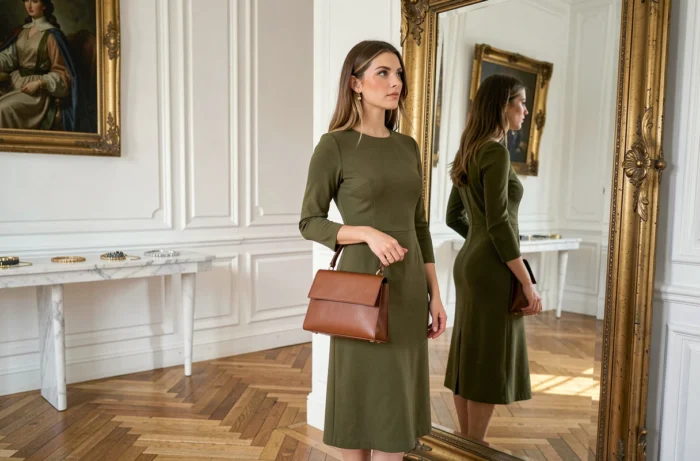
A bag works on the same principle. A brightly colored bag paired with a neutral outfit creates enough contrast to catch the eye. Conversely, a structured black leather bag paired with a colorful outfit tones down the overall look and brings it together.
Fashion accessories and traceability: an increasingly important factor in what we buy
The European Ecodesign for Sustainable Products Regulation (ESPR), in force since July 2024, is paving the way for a digital product passport for textiles. The work plan adopted by the European Commission in April 2025 sets out specific work on textiles and clothing, with a delegated act tentatively expected in 2027.
In practical terms, this means that the origin and composition of an accessory will become traceable via a QR code or an embedded chip. For consumers, this offers another way to make informed choices: before buying, they’ll be able to check the actual material of a leather belt or the origin of a silk scarf.
This regulatory framework for accessories is still provisional. Timelines will depend on the final schedule for the delegated acts. In the meantime, some brands are getting ahead of the curve by voluntarily disclosing the traceability of their materials—a useful quality signal when choosing a durable piece.
What this means in everyday life
An accessory with a known origin is more likely to last. It’s easier to invest in a belt or bag when you know exactly what it’s made of. Choosing fewer, better-documented accessories also fits with the idea of personalization: one well-made piece that you customize with charms or a scarf is better than five impulse buys that wear out within a few months.
One final point worth noting: tying a scarf to a bag, using a belt to reshape a blazer or attaching a charm to a zipper—each of these takes just a few seconds. The difference between an ordinary outfit and a statement look isn’t the number of pieces you add, but how precisely you place them.