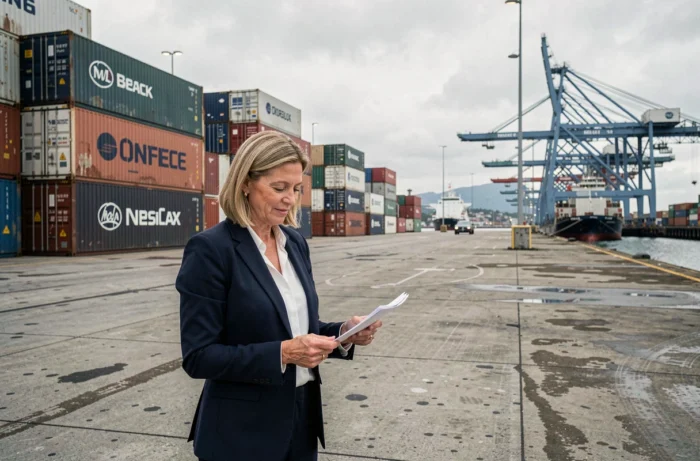
Canada derives about one-third of its revenue from exports. In Saskatchewan, that figure reaches about 45% of provincial GDP, the highest in the country. This reliance on foreign trade puts international commerce at the heart of Canada’s economic structure at a time when global trade tensions are intensifying and U.S. tariffs are disrupting supply chains.
Canadian service exports: the less visible engine of growth
Analyses of Canadian trade often focus on natural resources and manufactured goods. Services tell a different story. According to Export Development Canada (EDC), services accounted for most of the real growth in exports over the past decade.
This contribution goes beyond services sold directly abroad. Professional, digital and transportation services add value to manufactured exports themselves. An exported industrial product often incorporates engineering, logistics and consulting services that do not always appear in goods statistics.
EDC also notes that service exports are already less concentrated in the United States than goods exports. In other words, the geographic diversification Canada is seeking to accelerate is further advanced in services than in raw materials or manufactured products. When examining the importance of international trade to Canada, this distinction between goods and services changes the usual picture of the country’s dependence on the U.S. market.

Interprovincial barriers: domestic trade as a brake on prosperity
Trade-driven prosperity is not determined solely at the country’s borders. Hearings in the Canadian Senate have highlighted a less publicized obstacle: barriers to trade between provinces make it harder for Canadian businesses to access their own national market.
The problem is tangible. Different standards from one province to another, professional certifications that are not recognized across provincial borders, and food regulations that vary from place to place: these obstacles fragment a domestic market that businesses should be able to operate in without friction.
Progress has been announced several times to reduce these barriers. Testimony gathered by the Senate indicates that these commitments do not always translate into tangible changes for businesses. This raises the question: can international trade reasonably be expected to drive Canadian growth if domestic trade remains hampered by administrative barriers?
- Professional certifications earned in one province are not automatically valid in another, limiting the mobility of skilled workers.
- Food and safety standards vary between provinces, forcing businesses to adapt their processes for each domestic market.
- Small and medium-sized businesses, which lack the resources to navigate these regulatory differences, are hit hardest.
Diversifying foreign markets: real progress and known limitations
With U.S. tariffs rising and Washington taking a protectionist turn, diversifying trade partners has become a stated goal of the Canadian government.
This figure needs some context. Diversification is progressing unevenly across sectors and regions. Provinces whose economies rely on energy or raw materials remain heavily oriented toward the U.S. market because of their geographic proximity and existing transportation infrastructure.
The Indo-Pacific and Europe are among the priority regions for expanding export opportunities. But diversifying exports requires investment in logistics, regulatory compliance and market knowledge that not all businesses can afford to make.

What diversification cannot solve on its own
Opening up new foreign markets does not automatically offset the loss of revenue caused by tensions with the United States. The Bank of Canada notes that the sharp increase in U.S. tariffs is weakening global demand, driving up prices and putting the Canadian and global economies on a lower growth path.
Capital flows add another layer of complexity. The United States still dominates global financial flows, meaning that even as Canada diversifies its export destinations, it remains exposed to U.S. economic decisions through other channels.
International trade and how Canadian businesses are adapting
The Bank of Canada observes that Canadian businesses are already adapting to this new trade reality. Supply chains are being reorganized, some businesses are looking for new suppliers, and others are adjusting their prices or target markets.
This adaptation comes at a cost. Exporting businesses must contend with greater uncertainty about market access conditions. Tariffs change profitability calculations and can make some exports unviable in the short term.
- Service-oriented businesses have a relative advantage: their exports are less affected by tariffs on physical goods.
- Agriculture and energy, which depend on heavy infrastructure geared toward the United States, have less flexibility to quickly redirect their trade flows.
- Canadian SMEs, which make up the majority of exporting businesses, often lack the resources to pursue several foreign markets at once.
International trade remains Canada’s main source of revenue, but the nature of that trade is changing. The contribution of services to export growth, persistent barriers to interprovincial trade and the limits of geographic diversification paint a more nuanced picture than the simple narrative of openness to global markets. Canada’s ability to benefit from trade will depend as much on domestic reforms as on international negotiations.